
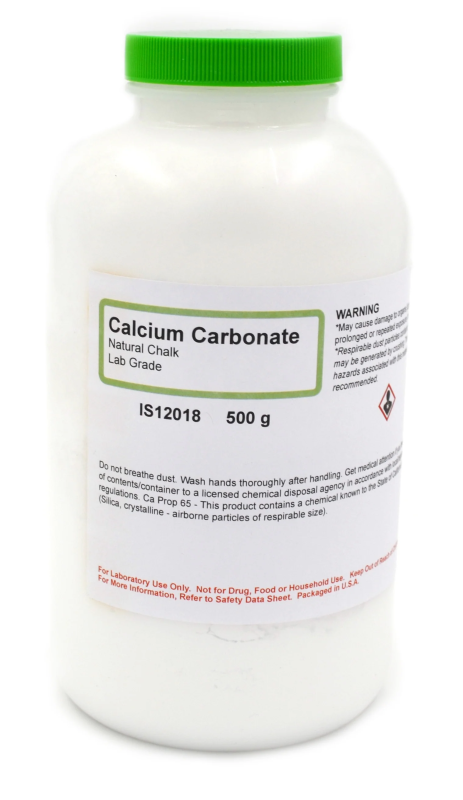
NATURAL CHALK CALCIUM CARBONATE, 500G, LABORATORY GRADE

Important Links
 Safety Operating Procedure
Calcium Carbonate (Natural Chalk) is a lab-grade ground limestone powder (CaCO₃, CAS 1317-65-3, >99.5%) supplied as an odorless white 325-mesh powder. In ceramics it is the standard source of calcium — a high-temperature flux in glazes, a whiting addition in casting bodies, and a common filler for adjusting opacity and surface. In the Atelier it also serves as a well-behaved model filler for soft-material work: adding it to water or a binder raises solid loading and yield stress in a controlled way, making it useful for building tunable non-Newtonian test suspensions, gesso and ground layers, and reference slurries for REP characterization.
Specs * Chemical: Ground limestone / calcium carbonate, CaCO₃ * CAS-No.: 1317-65-3 (may contain 0.1–1.0% quartz, CAS 14808-60-7) * Purity: >99.5% (water <0.5%) * Particle size: 325 mesh (~44 µm) * Molecular weight: 100.09 g/mol * Specific gravity: 2.71 * Solubility: 0.001% in water @ 0 °C; soluble in dilute acids * Decomposition: 825 °C (1517 °F), releasing CO₂ * Quantity: 500 g bottle | Shelf life: 36 months | Storage code: Green * GHS: WARNING — GHS08, STOT-RE Category 2 (H373, lungs, inhalation)
Hazards
H373 — prolonged or repeated inhalation may damage the lungs. Trace crystalline silica is listed under CA Prop 65 as a carcinogen.
Fine 325-mesh powder becomes airborne easily; ACGIH TLV is 5 mg/m³ respirable fraction.
Abrades eyes and skin; ingestion causes gastrointestinal irritation and blockage.
Effervesces on contact with acids, releasing carbon dioxide gas — do not mix in closed containers.
Things to Avoid
- Do not breathe dust (P260) — this is the one hazard that matters for this material.
- Do not dry-sand, grind, or crush the powder; crushing generates respirable crystalline silica.
- Do not mix with acids in closed or partially closed containers.
- Do not store near acids or in humid conditions.
- Not for drug, food, or household use — laboratory and studio use only. Keep out of reach of children.
Safety Checks
- Read the bottle label and confirm the SDS is on file before opening.
- Work in a well-ventilated area, fume hood, or with local exhaust — dusty conditions require a NIOSH/MSHA-approved respirator.
- Put on an N95 dust mask before opening the bottle; this is the primary control for this material.
- Confirm eyewash station and safety shower are accessible.
- Remove contact lenses; do not eat, drink, or store food in the work area.
Operational Checks
- Weigh into a tared container slowly and close to the bench to limit airborne dust — never pour from height.
- Keep the bottle closed between weighings; the powder is fine and clumps slightly with humidity.
- When adding to water or slip, sift in gradually and mix — dumping causes agglomerates that resist dispersion.
- Never combine with acids in a sealed vessel; CO₂ evolution will pressurize the container.
- Keep away from fluorine, alum, ammonium salts, and mercury/hydrogen mixtures.
- Not flammable and will not support fire — no ignition-source precautions needed.
Cleanup
- Sweep or HEPA-vacuum spills into a suitable container — never dry-brush or blow with compressed air.
- Wash the spill area with soap and water afterward.
- Avoid runoff into storm drains and ditches leading to waterways.
- Reseal the bottle tightly and return to cool, dry, well-ventilated storage.
- Remove and wash contaminated clothing before reuse; wipe down the balance and bench.