
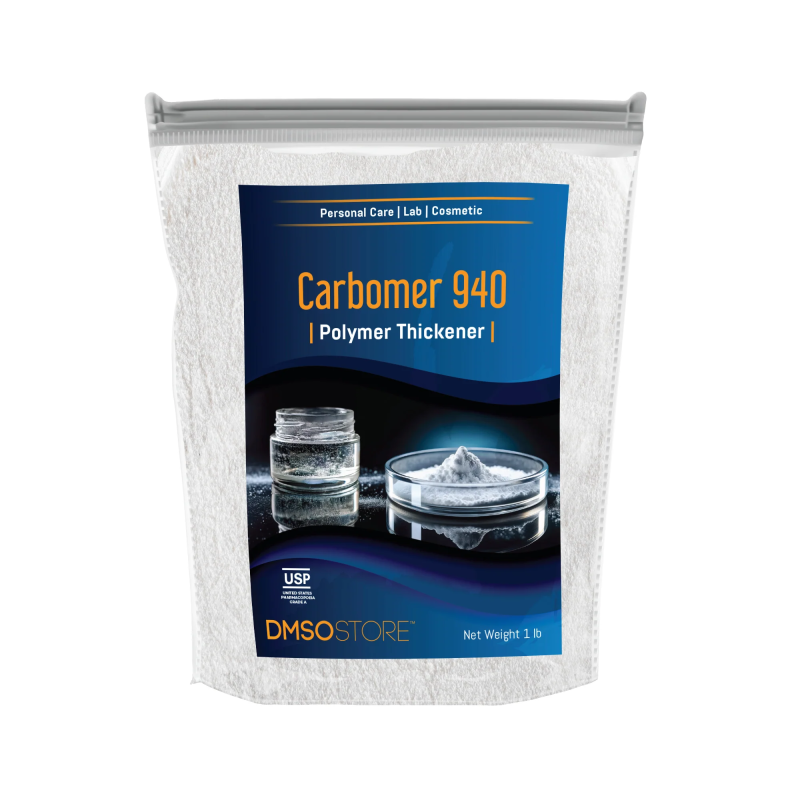
Carbomer 940

Important Links
 Safety Operating Procedure
Carbomer 940 is a high-molecular-weight crosslinked polyacrylic acid polymer used as a thickening, gelling, and suspending agent for aqueous systems (USP grade). Supplied as a fluffy white acidic powder, it swells in water and, once neutralized with a base such as triethanolamine or NaOH, forms clear high-viscosity, shear-thinning gels at very low concentrations. In the lab, it serves as a well-characterized model hydrogel and yield-stress fluid—useful for rheology reference measurements, suspension/emulsion stabilization, and preparing tunable soft-material test samples.
Specs * Chemical: Crosslinked polyacrylic acid (carbomer), (C3H4O2)x * CAS-No.: 9003-01-4 | INCI: Carbomer | Grade: USP * Form: White, fluffy, hygroscopic powder; faint characteristic odor * Acidity: ~pH 2.5–3.3 in 0.5–1% aqueous dispersion (acidic before neutralization) * Neutralizer: ~1–2% triethanolamine (TEA) or NaOH to reach pH ~6–7 for peak gelation * Typical use level: ~0.1–1% in water * Behavior: Disperses/swells in water; forms clear gel on neutralization * GHS: Not classified (no pictogram or signal word required) * Practical hazards: Dust irritation + combustible dust * NFPA: Health 1 / Fire 1 / Reactivity 0 * Incompatibilities: Strong oxidizers; high electrolyte/cationic content and low pH reduce gel viscosity
Hazards
Dust irritation: airborne powder can irritate eyes and the respiratory tract; sensitive individuals (e.g., asthmatics) may react * Combustible dust: fine powder can form explosive dust clouds; ignitable by heat, sparks, or static * Slippery when wet: hydrated/neutralized gel makes floors and surfaces very slick * Mildly acidic: unneutralized dispersions are low-pH * Hygroscopic: absorbs moisture, clumping if left open
Things to Avoid
- Creating dust clouds; inhaling the powder
- Ignition sources, open flame, and static near airborne dust
- Getting powder or gel in the eyes
- Leaving the container open (moisture uptake and caking)
- Contact with strong oxidizers
- Discharging bulk powder or gel into drains or waterways
Safety Checks
- Adequate ventilation / work near local exhaust if handling larger quantities
- No ignition sources, open flames, or static-generating conditions nearby
- PPE on (glasses, dust mask if dusty, gloves) before opening the container
- Container labeled and kept tightly closed; stored away from oxidizers
- Eyewash accessible; spill/absorbent cleanup ready
Operational Checks
- Weigh and transfer gently to minimize dust; avoid pouring from height or using compressed air
- Disperse slowly into water with stirring to avoid clumps ("fish eyes")
- Neutralize with TEA/NaOH to target pH to develop the gel
- Keep away from heat and incompatible materials during handling
- Wash hands after handling and before breaks
Cleanup
- Sweep or vacuum spilled powder gently—avoid raising dust; a HEPA/particle-filter vacuum is preferred
- Use damp wiping for residual powder rather than dry brushing or air
- Collect in a labeled closed container for disposal
- Wipe up hydrated gel promptly (slip hazard); do not wash bulk powder or gel down drains
- Reseal the container; store cool and dry; log usage