
Silicone Oil

Important Links
 Safety Operating Procedure
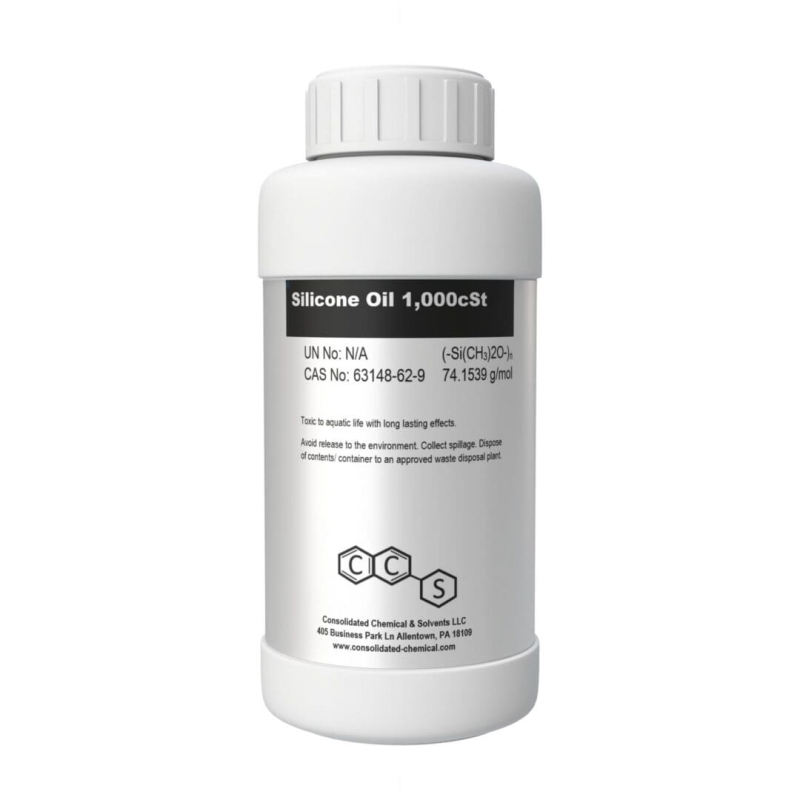
Silicone oil (1000 cSt) is a colorless, viscous polydimethylsiloxane (PDMS) fluid used as a laboratory chemical, lubricant, damping and heat-transfer fluid, and Newtonian viscosity reference. It is chemically inert, thermally stable, non-volatile, and essentially odorless, with very low acute toxicity but classified as toxic to aquatic life. In the lab, it serves as a well-characterized model fluid and calibration standard—useful for rheometer/viscometer verification, soft-material sensing tests, and as a stable reference against which non-Newtonian materials (slips, gels, pastes) can be compared.
Specs * Chemical: Polydimethylsiloxane (PDMS), (Si(CH3)2O–)n * CAS-No.: 63148-62-9 * Appearance: Colorless, viscous liquid; odorless * Kinematic viscosity: 1000 cSt (mm²/s) at 25 °C * Relative density: 0.97 g/mL at 25 °C * Flash point: 101.1 °C (214 °F), closed cup — combustible liquid * Auto-ignition: >400 °C; decomposition >200 °C * Freezing point: −55 °C * Vapor pressure: <7 hPa (<5 mmHg) at 25 °C * Water solubility: Slightly soluble * GHS: Aquatic toxicity Cat. 2 (H401/H411) — no health/physical pictogram required * NFPA: Health 0 / Fire 1 / Reactivity 0 * Incompatibilities: Acids, bases, strong oxidizers
Hazards
Burns on strong heating; vapours are heavier than air and can form explosive mixtures under intense heat.
Causes mild skin and eye irritation on contact.
Toxic to aquatic life with long-lasting effects — keep out of drains and waterways.
Spilled oil makes floors and benches extremely slippery.
Under fire, decomposes to release carbon and silicon oxides.
Things to Avoid
- Strong heating, open flame, or ignition sources near the fluid
- Contact with acids, bases, or strong oxidizing agents
- Release to drains, soil, or waterways
- Generating mist or aerosols without respiratory protection
- Leaving spills unattended (slip hazard)
- Mixing waste with other chemical streams
Safety Checks
- Adequate ventilation for the work area
- No open flames or ignition sources if heating near the flash point
- PPE on (glasses, nitrile gloves) before handling
- Containers labeled and tightly closed; incompatibles stored separately
- Absorbent/spill kit available and drains protected before dispensing
Operational Checks
- Work over a tray or containment to catch drips
- Avoid skin/eye contact and breathing any mist; don't generate aerosols
- Keep away from strong heat, open flame, and incompatible materials (acids, bases, oxidizers)
- Dispense only what's needed; reclose the container promptly
- Wash hands after handling and before breaks
Cleanup
- Contain spills with liquid-absorbent material; cover and protect drains
- Collect, bind, and pump off; place in a labeled chemical-waste container
- Never pour down the sink or into drains (aquatic toxicity)
- Thoroughly degrease slippery residue from surfaces and floors
- Dispose per institutional and local regulations; keep in original container, no mixing with other waste